Skip to the main content.

Personal Loans

Whether you're covering unexpected expenses, making a big purchase, or just need extra cash, our personal loans offer simple, flexible funding tailored to your needs.

Learn more...

Consolidation Loans

Simplify your finances with a loan that combines multiple payments into one. Our consolidation loans help reduce stress and keep your budget on track.

Learn more...

Home Improvement Loans

Upgrade your living space with financing designed for renovations, repairs, or remodeling. Our home improvement loans help you enhance your home’s comfort, value, and functionality—on your terms.

Learn more...

Symple Insights

Explore expert insights, financial tips, and strategic guidance from the Symple Lending team. Our insights and resource articles are your go-to source for empowering content that helps you make informed decisions on your journey to financial freedom.

Learn More...

Symple News

Stay up-to-date with the latest press releases, media features, and major announcements from Symple Lending. This section showcases how we're making headlines and driving innovation in the lending industry.

Learn More...

3 min read

The 2026 Debt Elimination Option Most Banks Don’t Proactively Share

The 2026 Debt Elimination Option Most Banks Don’t Proactively Share
6:01

If you walk into a bank or log into your credit card account, you’ll see the same familiar options:

Make a payment.
Check your balance.
Maybe request a credit limit increase.

What you won’t typically see is guidance on how to pay off those balances faster and more efficiently.

That’s not because better options don’t exist.

It’s because the system most people use—credit cards—is designed to function a certain way. And unless you actively look beyond it, you’ll likely stay within it.

For many borrowers, that means continuing to manage balances month after month without ever stepping back to ask a different question:

Is there a more efficient way to eliminate this balance entirely?

Why This Option Isn’t Front and Center

Credit cards are one of the most widely used financial tools in the country.

They’re flexible, accessible, and easy to maintain.

But they’re also structured as revolving accounts, which means:

  • There’s no fixed payoff timeline
  • Interest is applied continuously
  • Minimum payments are designed to keep the account active

From a structural standpoint, this system works exactly as intended.

Balances remain manageable in the short term, and borrowers can continue using their accounts without disruption.

But that same structure can also extend repayment over many years—especially when balances grow.

That’s why alternatives that focus on eliminating balances more efficiently aren’t always emphasized in the same way.

The Overlooked Alternative

For borrowers carrying significant credit card balances, there is another approach—one that shifts the focus from ongoing management to structured repayment.

It’s called debt consolidation through a fixed-rate personal loan.

In this structure, a lender issues a personal loan that is used to pay off existing credit card balances in full.

Instead of managing multiple revolving accounts, the borrower transitions to:

  • One fixed monthly payment
  • One fixed interest rate
  • One defined payoff timeline

The goal isn’t to avoid repayment. It’s to complete it more efficiently.

A Simple Comparison

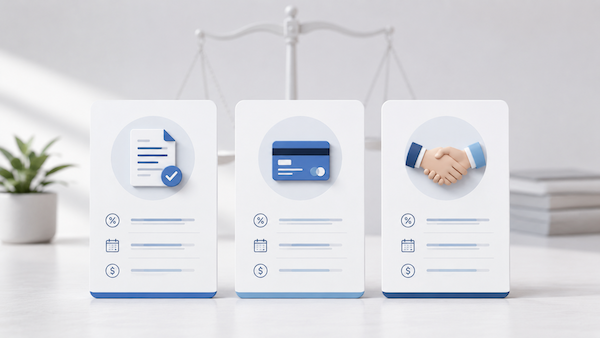
Here’s how the two structures differ:

Credit Cards

  • Variable interest rates
  • Multiple payments and due dates
  • No defined payoff timeline
  • Ongoing interest across several balances

Structured Loan

  • Fixed interest rate
  • One predictable monthly payment
  • Defined payoff date
  • Interest applied within a set schedule

The balance itself doesn’t change. But the way it’s repaid—and how long it takes—often does.

A $40,000 Example

Consider a borrower carrying $40,000 across multiple credit cards with average rates around 24% APR.

In that structure:

  • Interest can exceed $800 per month
  • Payments are spread across several accounts
  • Progress may feel slow despite consistent payments

Now compare that to a consolidation scenario.

If those balances are replaced with a loan around 11–12% APR:

  • Monthly interest drops significantly
  • Payments are consolidated into one
  • A defined payoff timeline is established

Instead of revolving indefinitely, the balance follows a structured path toward zero.

Why This Works

The effectiveness of this approach comes down to two key differences:

1. Interest Efficiency

With a lower rate, more of each payment goes toward reducing the balance rather than servicing interest.

2. Defined Timeline

A structured loan has a clear endpoint. Every payment moves the borrower closer to a known payoff date.

Together, those factors can significantly change the pace of repayment.

Credit cards are designed to keep balances revolving, not to eliminate them quickly.

That doesn’t make them a bad tool—but it does explain why many borrowers look for alternatives once balances reach a certain level.

Why It’s Not Always Highlighted

It’s not that this option is hidden.

It’s that it isn’t always the default.

Credit cards are designed for flexibility and ongoing use. Structured loans are designed for completion.

Because of that difference, borrowers often need to actively explore consolidation options rather than encountering them in the same way they encounter credit card features.

This isn’t about one option being right or wrong.

It’s about choosing the structure that aligns with your goal—whether that’s maintaining flexibility or accelerating repayment.

Who This Approach Is Designed For

This type of consolidation strategy is typically most relevant for borrowers who:

  • Carry $20,000 to $100,000 in credit card balances
  • Have credit scores of 580 or higher
  • Maintain stable income
  • Are making payments but want a more efficient path forward

Many people in this category are already managing their accounts responsibly.

They’re simply operating within a system that wasn’t built for speed.

A Different Perspective

For years, the default approach to credit card balances has been straightforward:

Make the payments. Stay current. Gradually reduce the balance over time.

And for smaller balances, that approach can work well.

But as balances grow, the structure begins to matter more.

That’s when some borrowers start to look beyond the default options and consider alternatives that offer:

  • More predictability
  • Greater efficiency
  • A clear endpoint

The fastest way out isn’t always the option that gets promoted the most.

The Takeaway

The most effective financial strategies aren’t always the most visible ones.

Sometimes, they’re simply the ones that require a shift in perspective.

For borrowers carrying high-interest credit card balances, that shift often comes down to one question:

Am I managing this balance—or actively working to eliminate it?

The answer isn’t about effort. It’s about structure.

And for many borrowers in 2026, that realization is what opens the door to a more efficient path forward.

Disclaimer: The information provided in this blog post is for educational and informational purposes only and should not be considered as financial, legal, investment, or tax advice. Symple Lending is not responsible for any financial outcomes resulting from following the information or ideas shared in this blog. Every individual's financial situation is unique, and we strongly encourage readers to take their own circumstances into consideration and consult with a qualified financial, legal, tax, and investment advisor before making any financial decisions. Symple Lending does not provide financial, legal, tax, or investment advice.

Track Spending in 10 Minutes a Week: A Lightweight System That Sticks

Track Spending in 10 Minutes a Week: A Lightweight System That Sticks

Managing your money shouldn't require hours of complex spreadsheet work. If you need to manage personal finances with a busy schedule, adopting a...

Continue Reading
Reset Your Budget with Smart Financial Planning When Finances Feel Tight

Reset Your Budget with Smart Financial Planning When Finances Feel Tight

A budget reset involves reviewing your income sources, prioritizing essential expenses, and reducing variable costs to align with your current...

Continue Reading
Simplify Banking: The Best Way to Organize Checking, Savings, and Sinking Funds

Simplify Banking: The Best Way to Organize Checking, Savings, and Sinking Funds

Have you ever felt wealthy checking your balance, only to remember a large insurance bill is due next week? According to financial experts, leaving...

Continue Reading
Debt Consolidation Loan Pros: 9 Benefits (with Real Examples)

1 min read

Debt Consolidation Loan Pros: 9 Benefits (with Real Examples)

Are you juggling multiple bills each month and wondering, is debt consolidation a good idea? For many Americans, rolling multiple balances into one...

Continue Reading
The Debt Payoff Strategy Financial Planners Recommend That Most People Overlook

1 min read

The Debt Payoff Strategy Financial Planners Recommend That Most People Overlook

When clients walk into a financial planner’s office carrying $20,000, $30,000, or more in high-interest credit card balances, the advice is rarely...

Continue Reading
Debt Consolidation Loan vs. Balance Transfer vs. Personal Loan: Which Fits Your Debt?

1 min read

Debt Consolidation Loan vs. Balance Transfer vs. Personal Loan: Which Fits Your Debt?

Managing multiple payments is like plugging five leaks in a boat. Industry data reveals these scattered balances force you to pay banks a massive...

Continue Reading