Skip to the main content.

Personal Loans

Whether you're covering unexpected expenses, making a big purchase, or just need extra cash, our personal loans offer simple, flexible funding tailored to your needs.

Learn more...

Consolidation Loans

Simplify your finances with a loan that combines multiple payments into one. Our consolidation loans help reduce stress and keep your budget on track.

Learn more...

Home Improvement Loans

Upgrade your living space with financing designed for renovations, repairs, or remodeling. Our home improvement loans help you enhance your home’s comfort, value, and functionality—on your terms.

Learn more...

Symple Insights

Explore expert insights, financial tips, and strategic guidance from the Symple Lending team. Our insights and resource articles are your go-to source for empowering content that helps you make informed decisions on your journey to financial freedom.

Learn More...

Symple News

Stay up-to-date with the latest press releases, media features, and major announcements from Symple Lending. This section showcases how we're making headlines and driving innovation in the lending industry.

Learn More...

2 min read

Loan Term Length 101: What “36 vs. 60 vs. 72 Months” Really Means

Loan Term Length 101: What “36 vs. 60 vs. 72 Months” Really Means
4:51

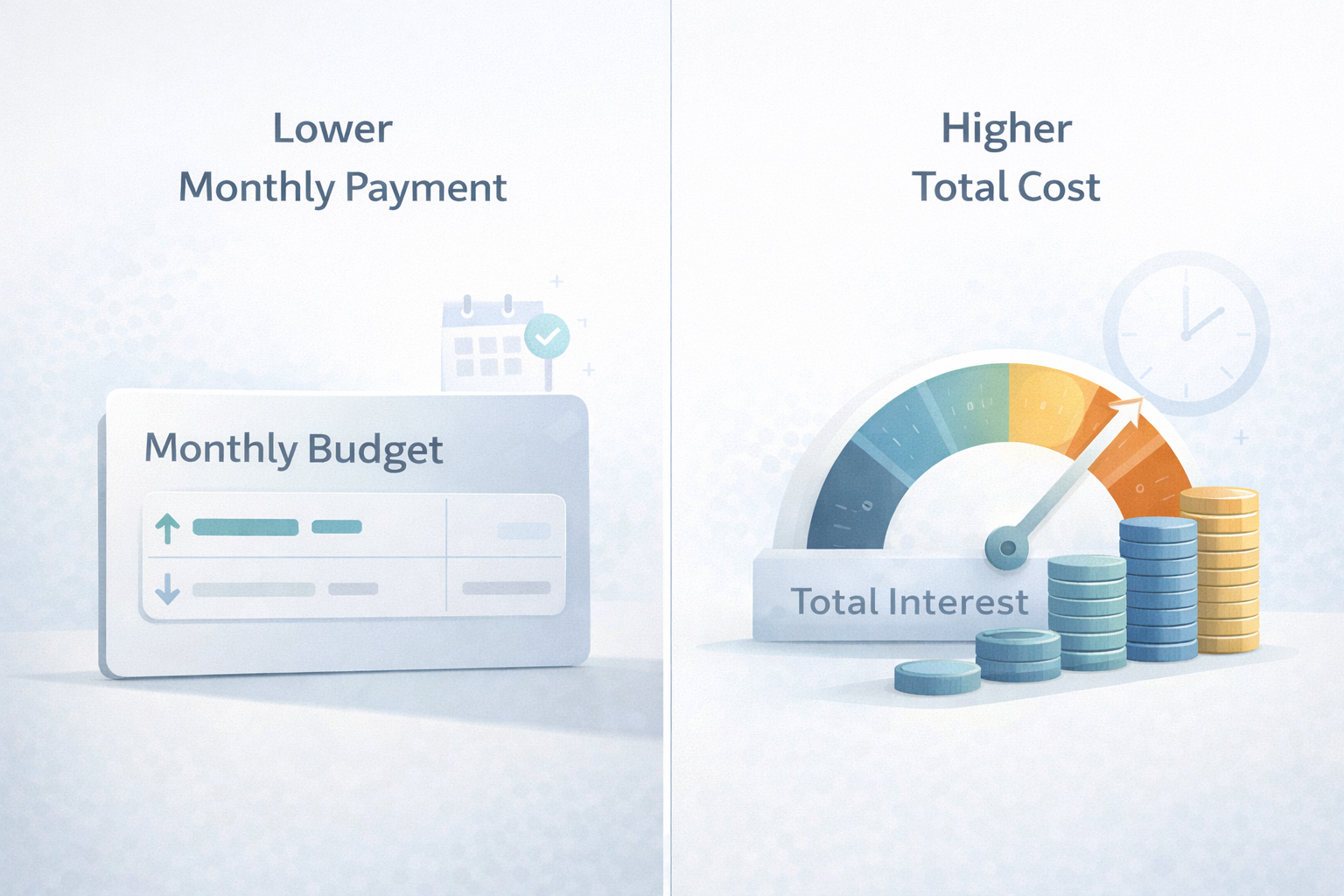
You’ve secured the funding, but now face a budget dilemma: do you prioritize a lower monthly payment or less total interest? Financial experts explain that a personal loan carries two price tags—the "Monthly Price" you pay today and the "Total Price" accumulated later. Your loan term length sets the clock for this tradeoff, translating 36, 60, or 72 months into three, five, or six actual years of commitment.

The $2,000 Difference: Why a Lower Monthly Payment Costs More Later

When reviewing a loan offer, the monthly payment acts as the immediate price tag, often overshadowing the true cost of borrowing. Extending your repayment timeline lowers that monthly bill, which adds convenience to your current budget, but it also gives interest significantly more time to accumulate. This "cost of convenience" means you effectively pay a premium for holding onto the bank’s money longer, transforming a manageable debt into a more expensive obligation.

Consider a $10,000 loan at a 10% APR across three common term lengths:

Loan Term Length Monthly Payment Total Interest Cost
36 Months (3 Years) ~$323/mo $1,616
60 Months (5 Years) ~$212/mo $2,748
72 Months (6 Years) ~$185/mo $3,322


While picking the 72-month option saves you nearly $140 every month compared to the 3-year plan, that flexibility comes with a steep price. You end up paying more than double the interest over the life of the loan. Seeing exactly how loan duration impacts interest helps you decide if a lower monthly commitment is worth the extra expense before you select the "clock" that fits your financial goals.

36, 60, or 72 Months: Which "Clock" Fits Your Financial Goals?

Selecting the right term requires looking past the numbers to see how the payment schedule affects your daily life. While short-term loan benefits include reaching your "Financial Freedom Date" sooner and minimizing total costs, this aggressive approach demands a tighter monthly budget. Compare your current financial situation against these common borrower profiles:

  • The Interest Saver (36 month loan): Perfect for those with stable income who prioritize being debt-free quickly over having extra spending money.
  • The Balanced Borrower (60 month loan): Often the "sweet spot," this option offers a moderate payment while preventing interest from spiraling out of control.
  • The Cash-Flow Prioritizer (72 month loan): Best when your monthly budget is tight; this provides long-term loan monthly payment relief at the cost of higher total interest.

Every borrower has different pressure points, so the "best" loan is simply the one you can consistently repay without straining your finances.

3 Critical Questions to Ask Before You Sign Your Loan Agreement

Before finalizing your loan term, run a quick "stress test" on your finances to prevent buyer's remorse. A loan acts as a fixed obligation that limits your flexibility, so you must ensure the monthly cost doesn't jeopardize your stability. Review these factors to verify your decision:

  • Is my budget resilient? If an emergency arises, can you still handle this monthly obligation, or is the payment too aggressive?
  • Is there a cost to quit? Does the lender charge a "prepayment penalty," or can you pay early to minimize the annual percentage rate impact over time?
  • Will this block future goals? Will this payment negatively affect your debt-to-income ratio considerations if you apply for a mortgage or car loan soon?

Choosing Your Path to Financial Freedom

Mastering the balance between personal financial health and loan length empowers you to make smarter borrowing decisions. By choosing the right loan term for your budget, you control your monthly obligations and total interest costs. Read more about how loan term length affects your financial future, then take the next step: Check Your Rate.

Disclaimer: The information provided in this blog post is for educational and informational purposes only and should not be considered as financial, legal, investment, or tax advice. Symple Lending is not responsible for any financial outcomes resulting from following the information or ideas shared in this blog. Every individual's financial situation is unique, and we strongly encourage readers to take their own circumstances into consideration and consult with a qualified financial, legal, tax, and investment advisor before making any financial decisions. Symple Lending does not provide financial, legal, tax, or investment advice.

Loan Term Length 101: What “36 vs. 60 vs. 72 Months” Really Means

Loan Term Length 101: What “36 vs. 60 vs. 72 Months” Really Means

You’ve secured the funding, but now face a budget dilemma: do you prioritize a lower monthly payment or less total interest? Financial experts...

Continue Reading
Smart Ways to Bounce Back From a Surprise Expense

Smart Ways to Bounce Back From a Surprise Expense

Nearly 4 in 10 Americans say they couldn't spare $400 to cover unexpected expenses without borrowing, and yet, surprise costs hit almost everyone at...

Continue Reading
Will a Consolidation Loan or Personal Loan Help Your Credit Score? Key Factors to Know

Will a Consolidation Loan or Personal Loan Help Your Credit Score? Key Factors to Know

You’ve likely heard that applying for new credit temporarily lowers your rating. While experts confirm a short-term dip is normal, the link between ...

Continue Reading
Choosing the Right Loan Term: Monthly Payment vs. Total Interest (3–7 Years Explained)

Choosing the Right Loan Term: Monthly Payment vs. Total Interest (3–7 Years Explained)

Salespeople often start with a dangerous question: "What monthly payment fits your budget?" While a lower bill feels safer, extending a loan simply...

Continue Reading
Consolidation Loan vs. Personal Loan Rates, Fees, and Total Cost: What to Compare

Consolidation Loan vs. Personal Loan Rates, Fees, and Total Cost: What to Compare

Staring at multiple bills makes it hard to tell if you’re saving money or just moving debt. In reality, consolidation loan vs personal loan rates...

Continue Reading
How Loan Term Length Affects Your Financial Future: Finding the Right Balance

1 min read

How Loan Term Length Affects Your Financial Future: Finding the Right Balance

Summary: Loan term length is a key driver of your monthly cash flow, total interest paid, and long-term financial flexibility. Shorter terms mean...

Continue Reading