Skip to the main content.

Personal Loans

Whether you're covering unexpected expenses, making a big purchase, or just need extra cash, our personal loans offer simple, flexible funding tailored to your needs.

Learn more...

Consolidation Loans

Simplify your finances with a loan that combines multiple payments into one. Our consolidation loans help reduce stress and keep your budget on track.

Learn more...

Home Improvement Loans

Upgrade your living space with financing designed for renovations, repairs, or remodeling. Our home improvement loans help you enhance your home’s comfort, value, and functionality—on your terms.

Learn more...

Symple Insights

Explore expert insights, financial tips, and strategic guidance from the Symple Lending team. Our insights and resource articles are your go-to source for empowering content that helps you make informed decisions on your journey to financial freedom.

Learn More...

Symple News

Stay up-to-date with the latest press releases, media features, and major announcements from Symple Lending. This section showcases how we're making headlines and driving innovation in the lending industry.

Learn More...

6 min read

How to Build an Emergency Fund from Scratch: A Step-by-Step Guide

How to Build an Emergency Fund from Scratch: A Step-by-Step Guide
12:16

Unexpected expenses can throw even the most careful budget off track, which is why having a small cushion matters more than most people realize.

Building an emergency fund isn't just for financial experts or high-income earners. It's a critical safety net everyone deserves, regardless of your current bank balance. The good news? You don't need thousands to start. The path to financial security begins with just a few dollars and one simple decision: starting today.How to Build an Emergency Fund From Scratch

Why Every Adult Needs an Emergency Fund

If you're struggling to save money, you're not alone. Many adults find it challenging to build up their savings accounts, and financial emergencies remain one of the top causes of stress in our lives.

An emergency fund is essential when life throws unexpected expenses your way, like medical bills, unexpected car repairs, or sudden job loss. Without this buffer, many people turn to credit cards or high-interest loans, creating a cycle of debt that's hard to escape.

Having even a small emergency fund gives you both practical protection and peace of mind. It provides financial breathing room when unexpected expenses arise and helps you sleep better at night knowing you have a cushion.

The best part? You don't need a massive paycheck to start building this protection. You just need consistency in adding money to a dedicated, separate savings account.

Debunking Myths and Misconceptions About Emergency Savings

"I need thousands saved before I can even start an emergency fund." Sound familiar? This common misconception prevents many from taking their first step toward implementing a solid savings strategy and building an emergency fund.

The truth: You can absolutely start an emergency fund from zero. Financial experts consistently recommend starting small and building gradually. Even setting aside $5-10 weekly in a dedicated emergency savings account creates meaningful protection over time.

What matters isn't how much you begin with, but simply that you start saving. Many successful emergency funds started with less than $100 and grew consistently through simple, stress-free steps.

Remember, emergency savings isn't about perfection, it's about progress. Each dollar you save increases your financial resilience, regardless of your current income or financial situation.

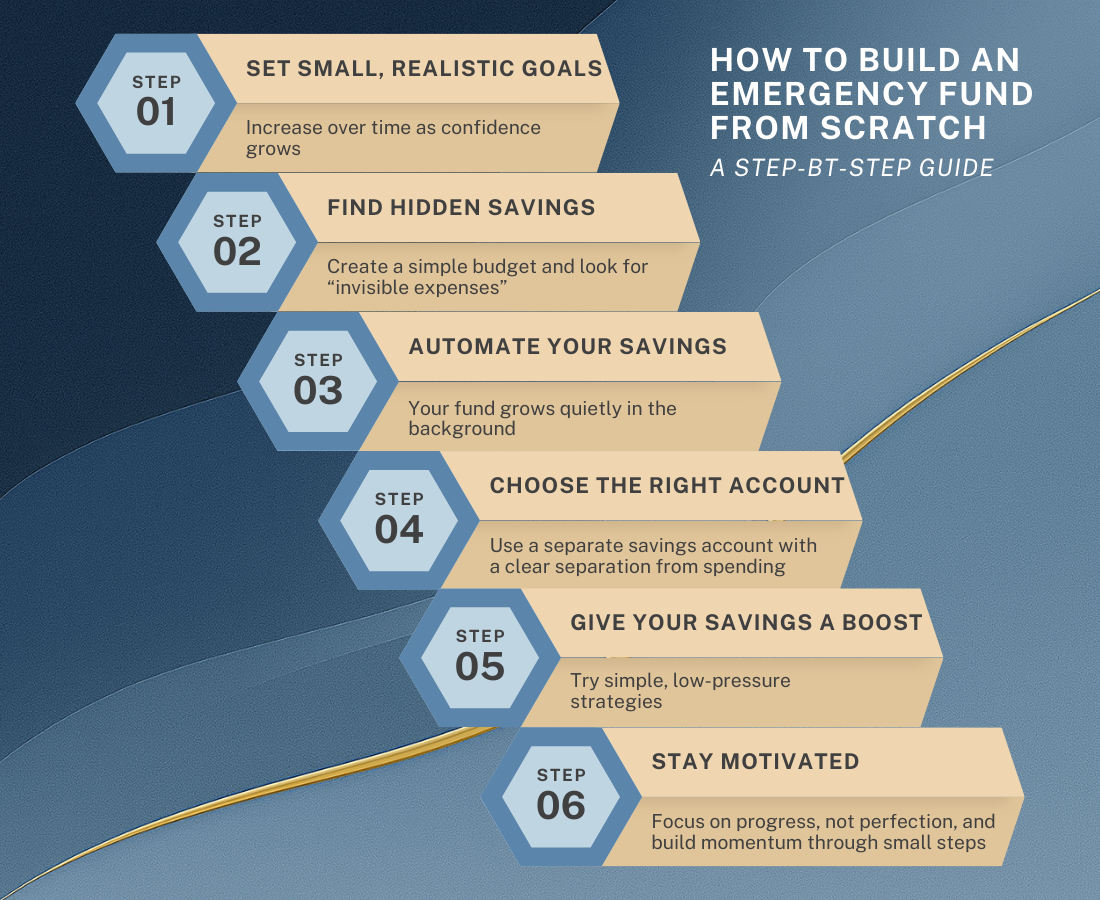
Setting Realistic Micro-Goals

Financial experts suggest aiming for an initial milestone of $1,000 for your emergency fund before working toward a larger safety net to cover unexpected expenses. This amount provides meaningful protection while feeling achievable.

Break your savings target into micro-goals to make the process less overwhelming. Setting aside just $10–$25 per week or per paycheck creates momentum without straining your budget. The goal isn't to save money fast, it's to save what you can in order to improve your financial well being.

This step-by-step approach aligns perfectly with proven strategies on how to build an emergency fund. Starting with small, consistent contributions allows you to:

  • Build the habit of saving regularly
  • Experience quick wins that boost motivation
  • Gradually increase your contributions as your financial confidence grows

Remember that consistent small steps are far more effective than waiting until you can make large deposits. Your emergency savings journey begins with that first small transfer, not when you reach a "perfect" starting amount.

Budgeting to Uncover Savings Opportunities

Creating a realistic budget is your first step to finding money for your emergency fund. Start by listing all your income sources alongside your fixed and variable expenses. Look at your necessary expenses (rent or mortgage payments, food, gas, utilities, and other living expenses) compared to your splurges (streaming services, dining out, gym memberships). This simple exercise often reveals spending you didn't realize was happening.

Focus on making small, consistent contributions rather than waiting for large chunks of money. Setting aside $20 weekly feels much more manageable than trying to save $500 at once.

Track your spending habits for just two weeks to find potential savings. Many people discover they're spending more than expected on:

  • Subscription services they rarely use
  • Takeout meals and coffee stops
  • Impulse purchases during online browsing

Redirecting even a portion of these "invisible expenses" can quickly build your emergency savings without feeling like a sacrifice. The key is identifying simple, stress-free steps that won't affect your quality of life but will steadily strengthen your financial safety net.

Consistent Savings with Automatic Transfers

Setting up automatic transfers is the single most effective way to build your emergency fund without willpower. Schedule a small amount to move from your checking account to your savings account right after each payday, before you have a chance to spend it.

You can create this automatic habit through:

  • Direct deposit splits between checking and savings accounts through your employer
  • Scheduled transfers through your bank's app
  • Weekly micro-transfers of even $5-10 to your savings accounts

Automation removes the temptation to spend the money you intended to save. When funds move automatically, you adjust your spending to what remains rather than trying to save what's left at month-end.

This set it and forget it approach works because it requires no ongoing decisions. Your emergency fund grows steadily in the background while you focus on daily life, making it the cornerstone of how to save consistently over time.

Choosing the Right Account for Your Emergency Savings Fund

Where you keep your emergency money matters as much as saving it. Use a dedicated account (preferably a high-yield savings account or money market account) that pays interest while keeping your funds accessible when needed.

The right account should:

  • Offer quick access to funds (within 1-2 business days)
  • Have minimal or no monthly fees
  • Earn some interest to help fight inflation
  • Not be tied to investment markets

Keeping emergency savings separate from regular checking accounts creates a psychological barrier that reduces the chance you'll dip into these funds for non-emergencies. This separation helps you track your progress clearly and protects your financial strategy.

Many online banks offer higher interest rates than traditional banks with no minimum balance requirements, making them perfect for those starting their emergency fund from scratch with simple, stress-free steps.

Creative Ways to Boost Your Savings

Finding extra money for your emergency fund doesn't require a raise or second job. When you receive unexpected income, like bonuses, tax refunds, or cash gifts, send at least a portion directly to your emergency savings account before it gets absorbed into daily spending. This way, you're more prepared for unplanned expenses that life may throw at you.

Try temporarily cutting one small expense and redirecting those funds. Pausing a streaming service for three months or making coffee at home for a few weeks creates painless savings opportunities.

Round-up apps offer another effortless approach. These apps connect to your debit card, round purchases to the nearest dollar, and automatically transfer the difference to savings. Spend $4.25 on coffee, and $0.75 goes to your emergency fund, helping you accumulate meaningful savings without changing your habits.

These small, consistent actions help you build financial safety without feeling the pinch, making emergency fund creation accessible regardless of your current budget constraints.

Overcoming Emotional Barriers to Saving

Many people feel inadequacy or fear when thinking about their emergency fund. "I should have more saved by now" or "I'll never save enough" are thoughts that often prevent progress before you even start.

The key is to focus on progress over perfection. Every $5 or $10 you set aside matters more than having the "perfect" savings plan or waiting for the "right" time to begin. Your financial stability builds through consistent action, not overnight transformation.

Building momentum through regular contributions creates a psychological advantage that large, occasional deposits can't match. When saving becomes a habit rather than an event, you're more likely to continue even during tight financial periods.

Remember: Your emergency fund isn't a reflection of your worth. It's simply a tool you're building over time. What matters isn't how quickly you reach your goal but that you're taking consistent steps forward.

Tracking Progress and Celebrating Milestones

Track your savings milestones regularly to maintain motivation while building your emergency fund. Setting small targets, like each $100 saved, gives you visible progress markers that keep you engaged in the process.

Use positive reinforcement by celebrating these achievements. Treat yourself to something small but meaningful when you hit a target to associate saving with positive feelings rather than deprivation.

This approach is especially powerful when saving money on a tight budget. Seeing your fund grow from $0 to $100, then $200 creates momentum that helps overcome the discouragement many feel when financial resources are limited.

Try creating a visual tracker; a simple chart on your refrigerator or a digital tracker in your banking app. Watching your progress in real-time reinforces your commitment and transforms abstract financial goals into tangible achievements you can see growing week by week.

Start Preparing for Financial Emergencies

Set up your first automatic savings transfer today, even if it's just $5 per week. Your banking app likely allows you to schedule recurring transfers in less than five minutes, putting your financial protection on autopilot.

Starting now, regardless of the amount, marks your first step toward financial freedom. Remember that every emergency fund begins with a single deposit and grows through consistency rather than large amounts.

If debt payments are making it difficult to find room for savings, consider exploring options like Symple Lending for debt restructuring. Consolidating high-interest debts could free up money in your budget to build your emergency fund faster.

The most important action isn't perfecting your savings plan, it's taking that first step. Your future self will thank you for the financial breathing room you're creating, one small transfer at a time.

Your Financial Safety Net Starts Now

Building an emergency fund from scratch isn't about having perfect finances or making dramatic sacrifices. It's about creating a simple, sustainable system that works quietly in the background while you live your life. Start with whatever you can ($5, $10, or $20 per week) and let consistency do the heavy lifting.

Your emergency fund journey begins with a single step: setting up that first automatic transfer today. Your future self will thank you when life throws its inevitable curveballs, and you can face them with confidence rather than panic. Financial security isn't built overnight, but it is built one small deposit at a time.

Disclaimer: The information provided in this blog post is for educational and informational purposes only and should not be considered as financial, legal, investment, or tax advice. Symple Lending is not responsible for any financial outcomes resulting from following the information or ideas shared in this blog.  Every individual's financial situation is unique, and we strongly encourage readers to take their own circumstances into consideration and consult with a qualified financial, legal, tax, and investment advisor before making any financial decisions. Symple Lending does not provide financial, legal, tax, or investment advice.

How to Build an Emergency Fund from Scratch: A Step-by-Step Guide

How to Build an Emergency Fund from Scratch: A Step-by-Step Guide

Unexpected expenses can throw even the most careful budget off track, which is why having a small cushion matters more than most people realize.

Continue Reading
The Six-Figure Squeeze: Why You're Earning Too Much to Struggle Yet Still Feel Broke

The Six-Figure Squeeze: Why You're Earning Too Much to Struggle Yet Still Feel Broke

Ever thought a six-figure salary would solve all your money worries? Think again. Across America, professionals with enviable incomes are silently...

Continue Reading
From Overwhelmed to In Control: How Debt Consolidation Can Simplify Your Financial Life

From Overwhelmed to In Control: How Debt Consolidation Can Simplify Your Financial Life

Did you know that the average American with credit card debt juggles balances across four different cards? That's four separate due dates, four...

Continue Reading
The Six-Figure Squeeze: Why You're Earning Too Much to Struggle Yet Still Feel Broke

The Six-Figure Squeeze: Why You're Earning Too Much to Struggle Yet Still Feel Broke

Ever thought a six-figure salary would solve all your money worries? Think again. Across America, professionals with enviable incomes are silently...

Continue Reading
From Overwhelmed to In Control: How Debt Consolidation Can Simplify Your Financial Life

From Overwhelmed to In Control: How Debt Consolidation Can Simplify Your Financial Life

Did you know that the average American with credit card debt juggles balances across four different cards? That's four separate due dates, four...

Continue Reading
Simple Strategies for Streamlined Bill Management That Save Time and Money

Simple Strategies for Streamlined Bill Management That Save Time and Money

Many households are managing a large stack of monthly payments—loans, credit cards, utilities, subscriptions—and the burden keeps growing. That’s a...

Continue Reading